
Cary, NC · Garage Door Service
Deciding Whether Your Cary Garage Door Is Worth Repairing
A look at which garage doors in Cary's 1967-2006 housing stock are worth repairing, which climate-driven failures show up first, and the one mistake that costs owners the most.
- Repairs & new doors
- Springs & openers
- Serving 6 nearby communities
How Local Conditions Play In
Most houses in Cary's service area were built between 1967 and 2006, with the median year sitting at 1998. That spread matters because it means the doors we see aren't uniform - a 1970 door and a 2005 door are different animals, different track widths, different spring systems, sometimes different hinge gauges entirely. Across the six named areas we work in, the bulk of garage doors date to the 1980s and 90s construction boom, which is the stretch where steel sectional doors with roll-formed panels became standard.
Cary sits in a cold-moderate climate band. That's not hard winters, but it's enough freeze-thaw cycling over 20 or 30 years to work on weatherstripping, lubricant, and the galvanized coating on torsion springs. A door that looked fine in June can bind in January because the cold has stiffened the grease in the bearing plates and the rollers are dragging. None of this is dramatic, but it's steady, and it's why a door that's 25 years old in this area usually needs more than a new remote - it needs the moving parts looked at before you decide anything about the panel itself.
What Is Going On
When a door from this build window stops working right, the failure is almost always in one of three places: the torsion spring, the rollers and track, or the opener's drive mechanism. The panels themselves - the steel skin you see from the driveway - tend to outlast everything else, especially on doors built after the mid-80s when galvanizing got better.
A spring that's lost tension doesn't usually snap outright; it starts by making the opener strain, which shortens the opener's life too. That's the pattern we see most in houses from the 1980s and 90s stock that makes up most of the six areas we cover: the spring goes soft first, the opener gets blamed second, and by the time someone calls, two things need attention instead of one.
Track and roller wear is the other common story, especially in doors that haven't been serviced since they went in. Steel rollers on steel track, running dry for 20-plus years, grind themselves and the track both. That's fixable almost every time. What isn't always fixable is a door where the frame itself has racked out of square - at that point you're not repairing a door, you're rebuilding one, and the math usually points toward replacement instead.
What It Costs
We can't give you a number without looking at the door - a spring job and a full track-and-opener job aren't the same call, and pretending otherwise would be a guess, not a quote. What we can tell you is what drives the cost up or down.
Age works against you here. A door built early in that 1967-2006 window is more likely to need a part that isn't on the truck - older hardware sizes, discontinued track profiles, opener models that stopped being made years ago. A door from the later end of that range, closer to the 1998 median, usually uses more common parts, which keeps the job simpler and faster.
The median household income across the service area runs around $75,359, and most owners we talk to are weighing a repair against a full replacement with that kind of budget in mind. For a door that's structurally sound - square frame, good panels, just worn hardware - repair is almost always the cheaper and faster path. For a door that's racked, rusted through at the bottom panel, or running an opener that no longer has parts available anywhere, replacement stops being the expensive option and starts being the sensible one.
The Common Mistake
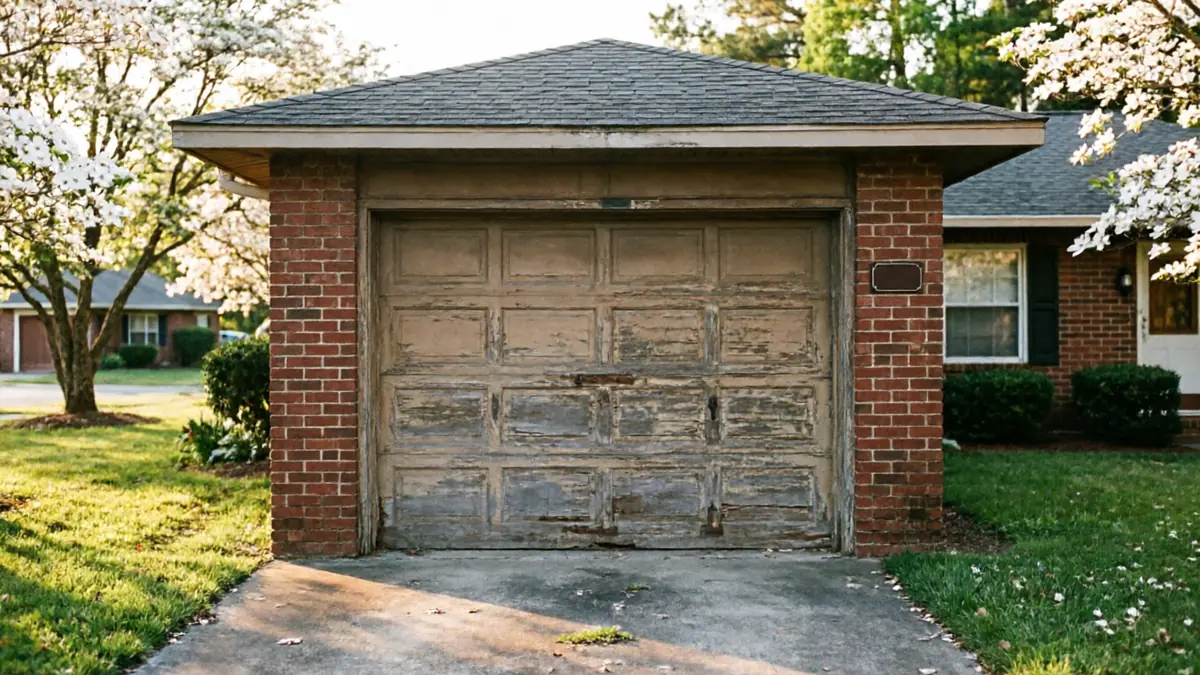
The mistake we see most often in this area is replacing a door that only needed a spring and a roller set. Someone sees a door that's stiff, slow, or noisy, assumes it's at the end of its life because it's 30 years old, and jumps straight to replacement pricing before anyone has actually opened the housing to look at the spring.
The opposite mistake happens too, though less often: someone keeps feeding parts into a door with a racked frame or a bottom panel that's rusted through from years of standing water, because the sticker price of a repair sounds better than the sticker price of a new door. That's money spent on a door that was never going to hold adjustment properly again.
The honest answer is that you can't tell which situation you're in from the driveway. A door that looks rough can have a perfectly sound frame and panels - it just needs the hardware serviced. A door that looks fine can have a frame that's quietly out of square. We don't guess on this one; it's worth an actual look before you spend money either direction.
Frequently asked questions
Is my garage door too old to repair if it was built in the 1980s or 90s?
Not on its own. Most of the doors we see in this area's housing stock are from that era, and age by itself doesn't rule out repair. What matters is the condition of the spring, track, and frame - if those are sound, the door's age is mostly a non-issue.
Why does my door get stiff in cold weather?
Cary's winters fall in a cold-moderate band, which is enough to stiffen grease in roller bearings and bearing plates on older hardware. It's a common complaint on doors from the 1980s and 90s stock that makes up most of this area, and it's usually a lubrication and hardware check, not a sign the door is failing.
How do I know if I should repair or replace?
Check whether the frame is square and the bottom panel is solid. If those are fine, a worn spring, opener, or roller set is almost always a repair. If the frame has racked or the panel's rusted through, replacement tends to be the better money even though the sticker number is higher.
Do you carry parts for older opener models?
Not always. Doors built early in this area's 1967-2006 construction window sometimes used opener models or hardware sizes that are no longer made. We'll tell you up front if a part needs to be sourced rather than pulled off the truck.
Related garage door services in Cary
More garage door guides
Book garage door service in Cary
Call now or request a quote - tell us what the door is doing and where you are.